

Making every tree count: strategic shading for river cooling
In a landscape where land is precious, river restoration isn't just about planting more trees—it’s about planting them where they matter most.
The Challenge: Land vs. Water
We know that riparian woodland is a critical tool for cooling warming rivers. However, we cannot simply reforest entire catchments. Land is a finite resource, often competed for by agriculture, housing, and infrastructure. By simulating thousands of solar interactions using detailed ray-tracing models, we have analyzed how trees cast shade on water. The data reveals that a strategic approach can achieve maximum cooling with a minimal land footprint.
Here are three rules for making every tree count:
Rule 1: Prioritize the "First Line"
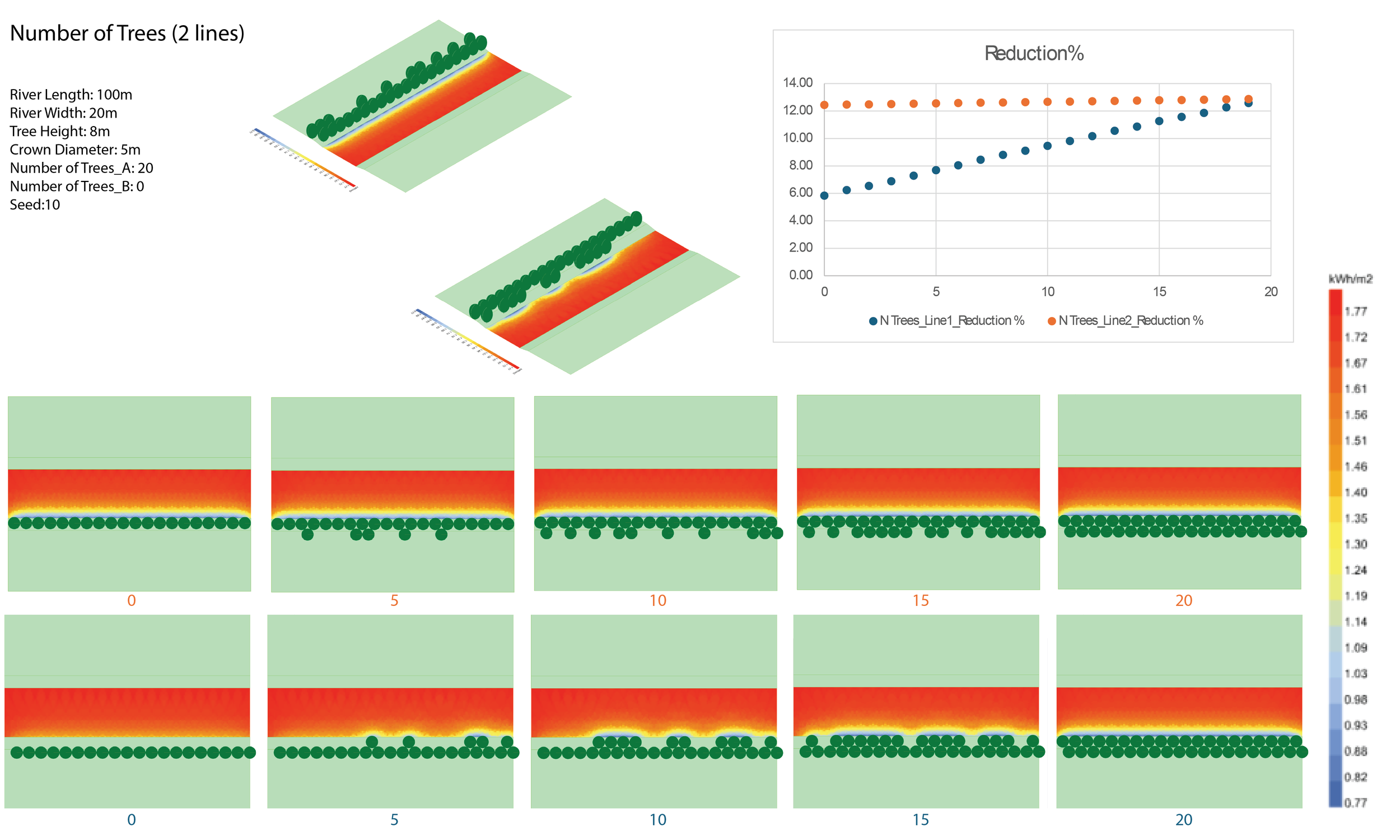
One of the most persistent myths in restoration is that you need a deep, dense forest buffer to cool a river. Our simulation data suggests otherwise.
We modeled the cooling efficiency of planting a single row of trees versus adding a second row behind it. The results show a clear saturation point:
The Power of the Edge: As shown in the Blue Series of our analysis, filling the immediate riverbank ("Line 1") yields a steady, linear increase in cooling (rising from ~6% to >12%). Every gap filled along the water's edge translates directly to reduced solar radiation.
The Law of Diminishing Returns: Conversely, as shown in the Orange Series, once the first line is established, adding a second row behind it offers negligible additional shading for the water surface.
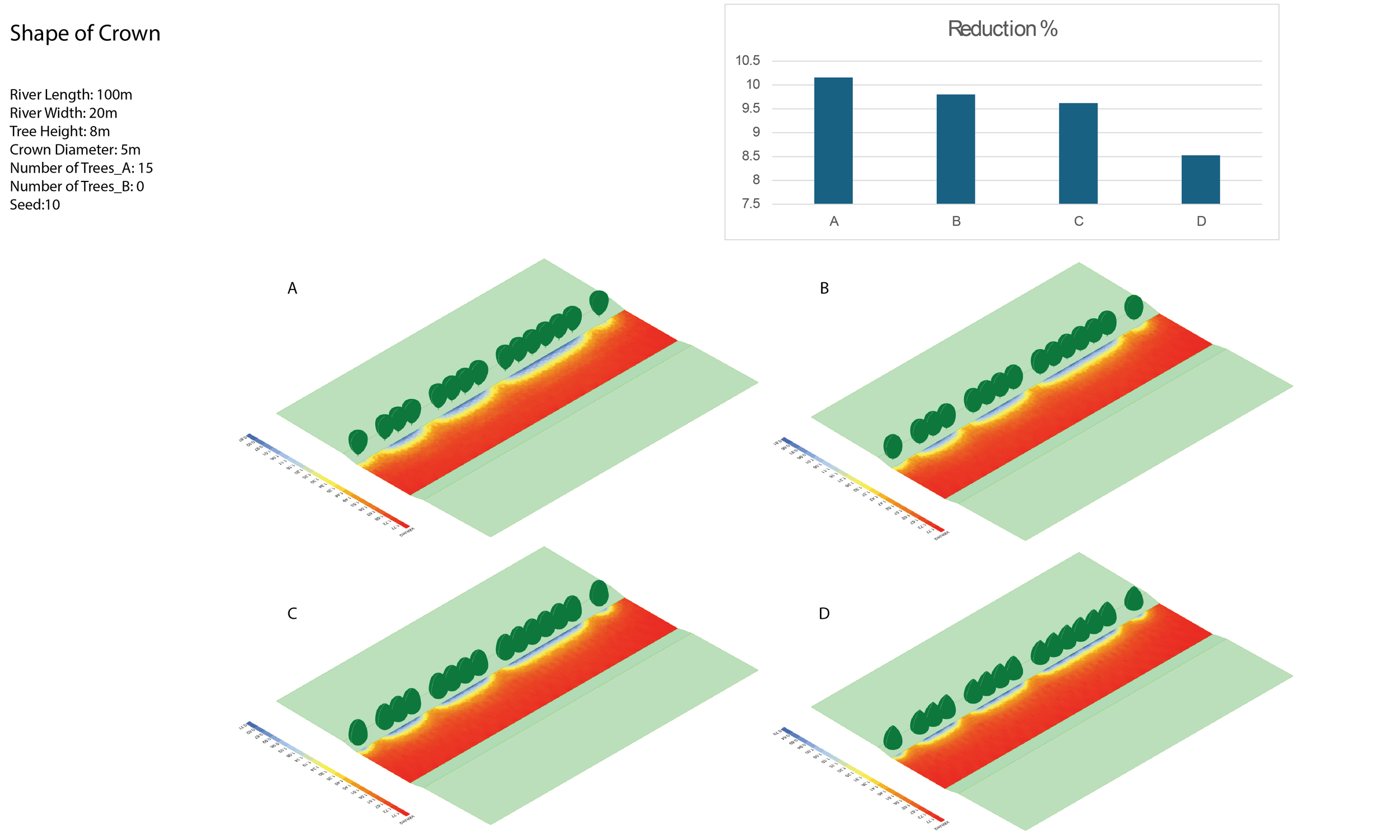
Rule 2: Crown Shape Matters
When selecting species for restoration, we often look at growth rate or biodiversity value. But for temperature management, the physical shape of the tree is decisive.
We analyzed four distinct crown shapes to determine their shading efficiency:
Broad is Better: Trees with wide, spreading crowns (Shape A, typical of broadleaf species like Oak or Beech) outperformed narrow, conical forms (Shape D, typical of some conifers) by a significant margin.
The Efficiency Gap: The difference in shading performance between the best and worst shapes is nearly 20%.
Strategy: On a per-tree basis, prioritize species with wide lateral spread. A broad canopy does the work of two narrow ones.
Rule 3: Know the Limits of River Width
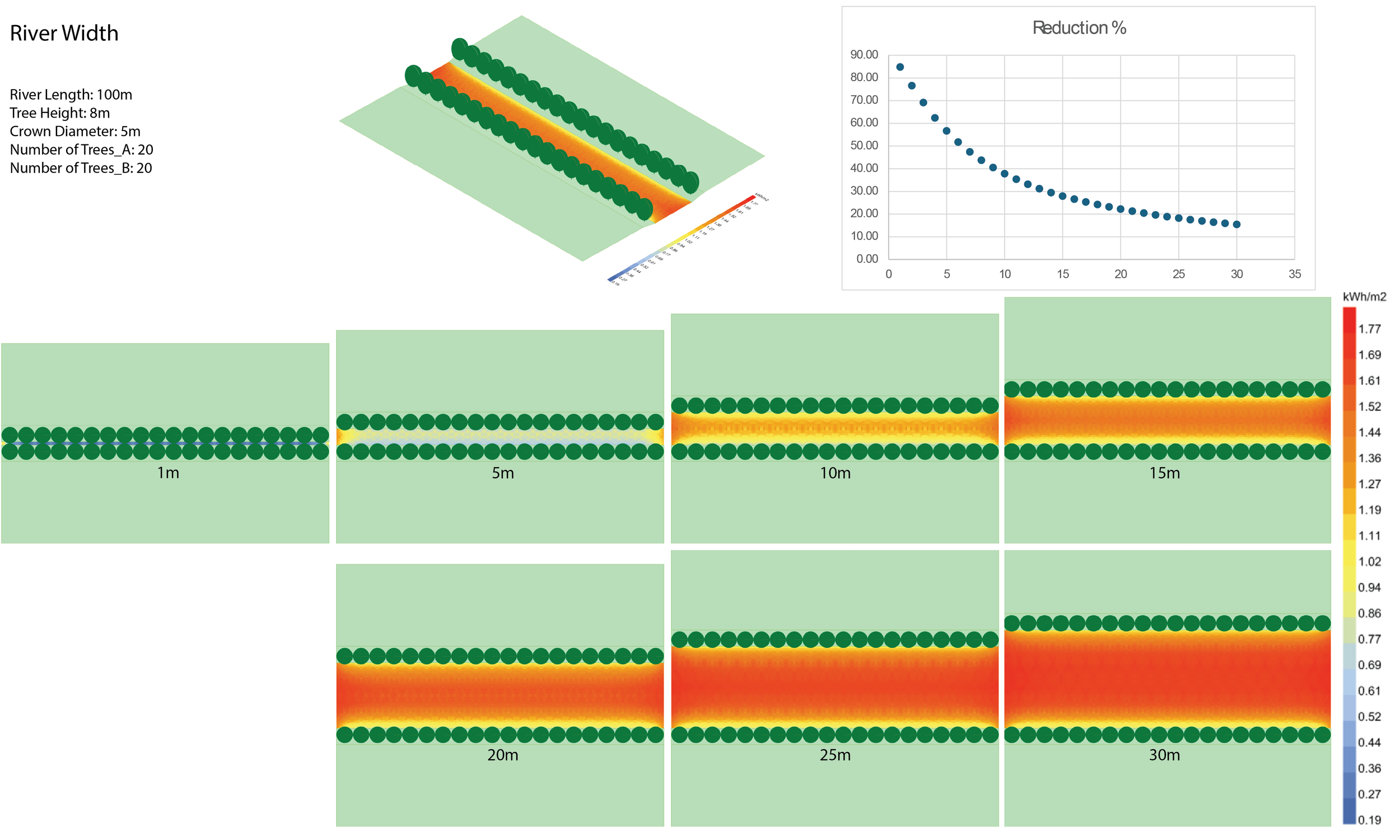
The river itself is the biggest variable. Our model demonstrates that shading potential decays exponentially as the channel widens.
Small Streams (<5m): Here, shading is highly effective. Even moderate vegetation can block >80% of solar radiation.
The 30m Threshold: On wide rivers (30m+), even a mature canopy struggles to reduce radiation by more than 20%.
Strategy: On wide rivers, "scattergun" planting is ineffective. We must use Targeted Orientation.
For wide channels flowing East-West (the most vulnerable to heating), planting must be concentrated strictly on the Southern bank.
Planting on the Northern bank of a wide river provides habitat, but its contribution to cooling is mathematically negligible.