

Mapping the cooling potential: the distribution of riparian woodland in Scotland
The Geographical Context
Scotland covers a land area of approximately 77,900 km², accounting for roughly 32% of the United Kingdom. Its geography is defined by a vast network of river catchments, ranging from the wet, mountainous west to the drier eastern lowlands.
However, within this diverse landscape, rising water temperatures pose a growing threat to aquatic ecosystems. Addressing this challenge requires understanding not just the rivers themselves, but the distribution and impact of the woodland that borders them.
Foundations: Insights from Literature
Our work builds directly on the spatio-temporal modeling developed by Jackson et al. (2018) and Jackson et al. (2021). Their work provided the essential baseline for predicting river temperature sensitivity across the country.
By synthesizing their findings, several key mechanisms became clear:
The 2°C Influence: Riparian woodland (specifically within a 25m buffer extending 1000m upstream) can alter maximum daily river temperatures by approximately 2°C.
Seasonal Dynamics: Trees function as a thermal buffer—providing a cooling effect in summer by blocking radiation, and an insulating effect in winter by retaining heat.
Regional Sensitivity: Their model identified the north, west, and Cairngorm Mountains as the regions most sensitive to climate change, largely due to the natural scarcity of riparian tree cover in these upland areas.
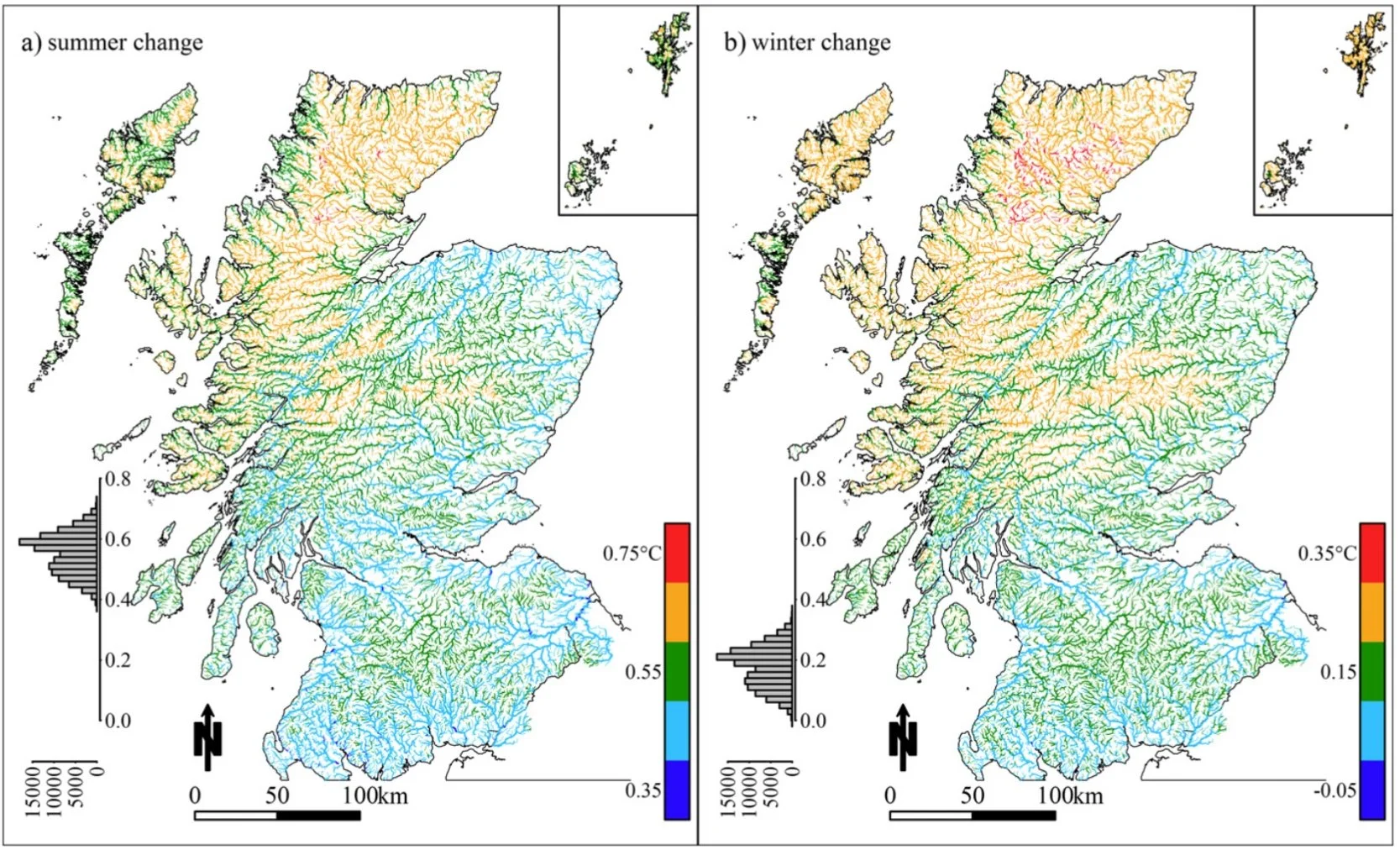
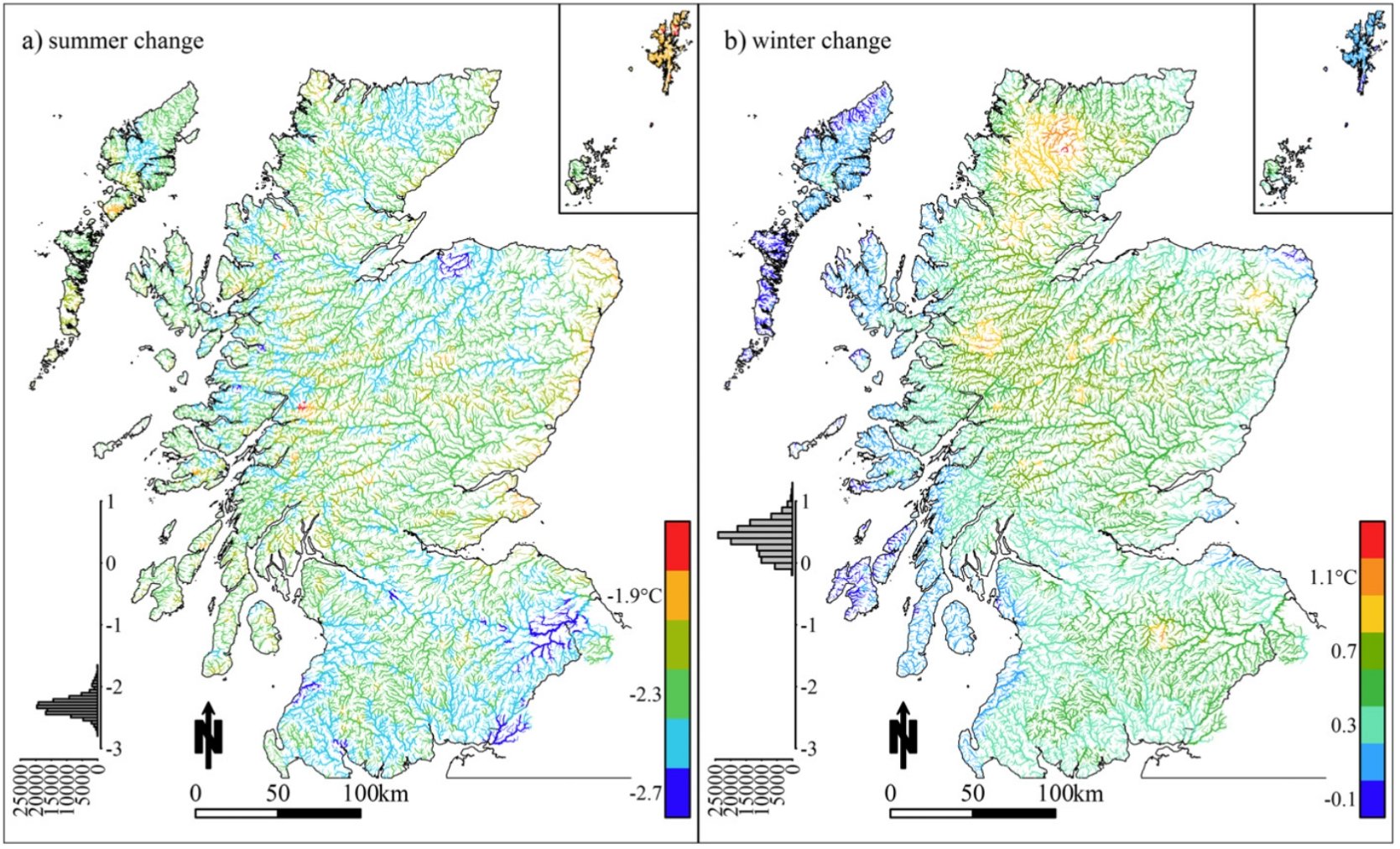
Fig. 2 Insight: Research indicates that increasing riparian woodland from 0% to 100% creates a drastic shift in daily temperature profiles, essential for protecting cold-water species like Atlantic Salmon. (Source: Jackson et al, 2018)
Our Contribution: Mapping and Geometric Analysis
While the literature established the theoretical sensitivity, translating this into effective restoration requires site-specific data. Leveraging datasets from Scottish Environment Protection Agency (SEPA), National Land Capability for Forestry by James Hutton Institute, and Riparian Woodland Scotland dataset by Scottish Government, we conducted a comprehensive spatial analysis of a 20m buffer along Scotland's watercourses.
Our analysis reveals that 81% (3,018 km²) of Scotland’s riparian zones currently lack woodland cover, indicating a massive theoretical potential for restoration.
The Reality Check: However, not all land is ready for planting. Environmental factors—including wind throw, soil wetness, and topography—render 923 km² of this area unsuitable for tree crops (Fig.3 (a)).
The Spatial Mismatch: A critical insight from our work is the discovery of a geographical disconnect. While previous studies (Jackson et al., 2018) identify rivers in the north, west, and Cairngorms as most sensitive to climate warming, our analysis shows these regions largely coincide with land that is physically difficult to plant (Fig.1, Fig.3).
High-Priority Targets: Despite these challenges, we identified 380 km² of non-wooded riparian land (approx. 17.7%) classified as offering "Good" to "Excellent" flexibility for tree growth. The Eastern and Southern Lowlands, along with specific catchments on the western coast, appear as the primary targets for riparian woodland restoration, where over 70% of unplanted riparian land is suitable for forestry.
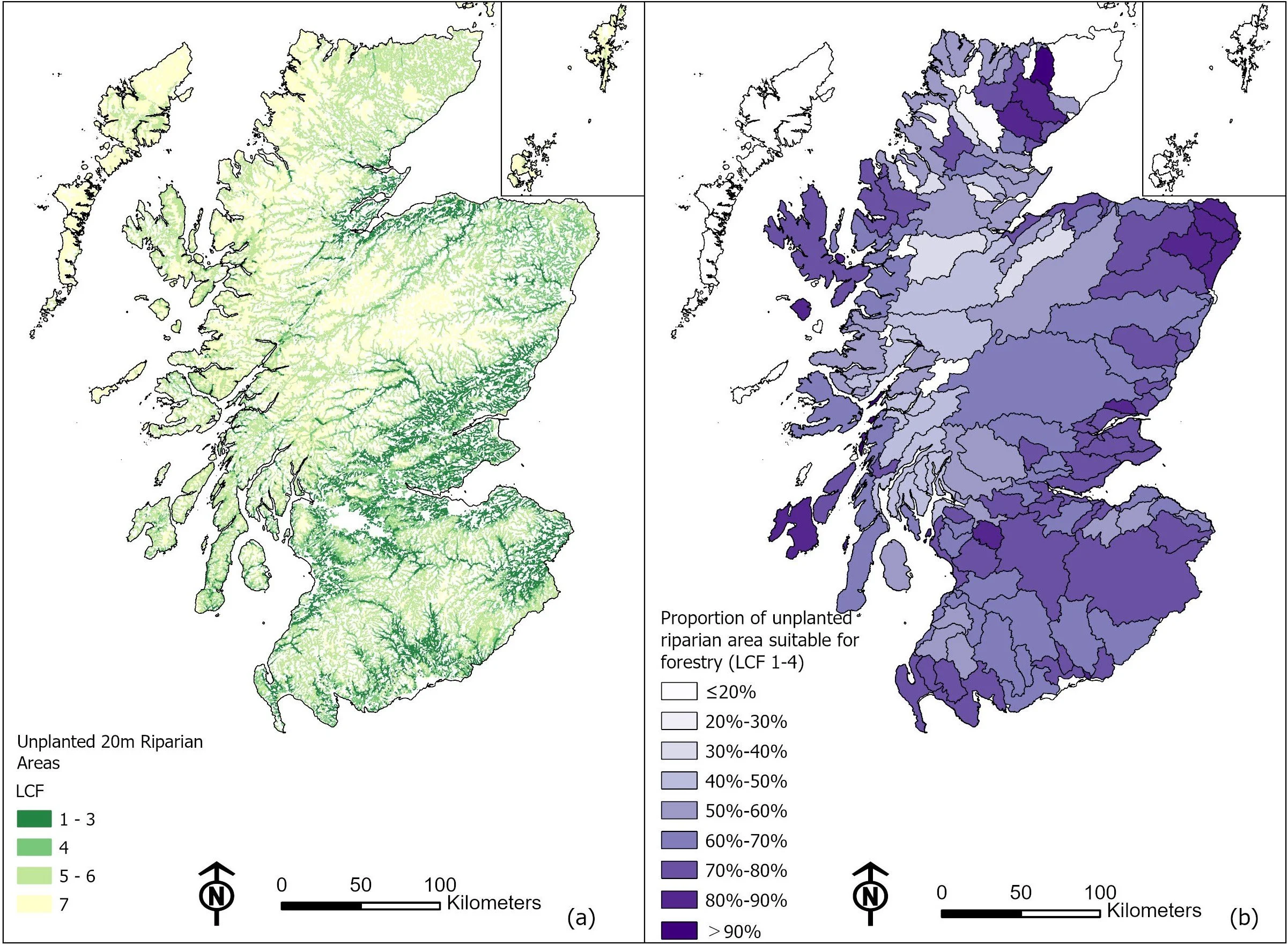
Fig. 1 Insight: Research indicates that rivers in northwest and Cairngorm mountains regions are most sensitive to climate change . Maps show the predicted change in maximum daily river temperature for a 1 °C change in maximum daily air temperature (Source: Jackson et al, 2018)
Fig. 3. Spatial analysis of riparian restoration potential in Scotland. (a) Currently unplanted riparian areas within 20m buffers, classified by Land Capability for Forestry (LCF). Dark green areas (LCF 1-3) represent high-priority targets for active planting. Lighter tones indicate decreasing suitability: LCF 4 offers moderate flexibility, LCF 5-6 indicate limited flexibility, and LCF 7 is unsuitable. (b) Catchment-scale prioritization. The map displays the proportion of unplanted riparian zones classified as suitable for forestry (LCF 1-4) within each catchment. Darker regions denote a higher share of suitable land, representing greater potential for active restoration.
To explore the data in depth, please visit our interactive map : Potential of Riparian Woodland Restoration in Scotland